
Okay, so a friend texted me about this “copper peptide” thing everyone’s suddenly obsessed with, and I went down a rabbit hole for approximately three hours, and here’s what I came back with: this molecule is basically two different people wearing the same name tag. One of them has an actual resume. Skincare gigs going back twenty-plus years, real human studies, receipts. The other one shows up to the interview with a mechanism and a lot of confidence and, when you ask for references, just kind of shrugs.
That second guy is the injectable version. Let’s talk about both of them, separately, because that’s the whole trick here.
What this stuff even is
GHK-Cu stands for glycyl-L-histidyl-L-lysine bound to a copper ion, which, sure, sounds like a spell from a fantasy novel, but it’s just three amino acids holding hands with a copper atom. Not synthetic, not some lab-cooked designer molecule. It’s yours already. Your body makes it.
A researcher named Loren Pickart found it back in 1973, poking around in human blood serum and noticing it made old liver tissue act younger [P1]. And here’s the detail that got everyone’s attention: the amount circulating in your blood actually drops as you age, from roughly 200 ng/mL around age 20 down to about 80 ng/mL by 60 [P2]. Which, I get it, that’s a compelling story to tell yourself at 2am while scrolling. Young blood has more, old blood has less, so what if we just… put it back?
Bound to copper, it’s not doing nothing, either. Copper is required fuel for an enzyme that stitches together collagen and elastin, and GHK seems to help ferry copper to where that repair work happens. In dish-and-tissue studies, it nudges up collagen, elastin, and the stuff that keeps skin plump, and it appears to flip switches on thousands of genes tied to repair and inflammation [P3][P2].
Here’s my “hold on” moment, though, and it’s the one the ads skip: almost all of that gene-flipping, genome-wide, several-thousand-genes stuff happened in cells in a dish, or in animals. Not in a person swallowing or injecting anything and reporting back “yep, felt younger.” Where actual humans have been tested, it’s been overwhelmingly on their skin, with a cream. So keep that straight in your head: real chemistry, real mechanism, solid cosmetic data, and a pretty thin file on what happens if you inject it into your whole body.
The part that’s earned its stripes: your face
I want to give credit where it’s due, because the skin story is genuinely decent.
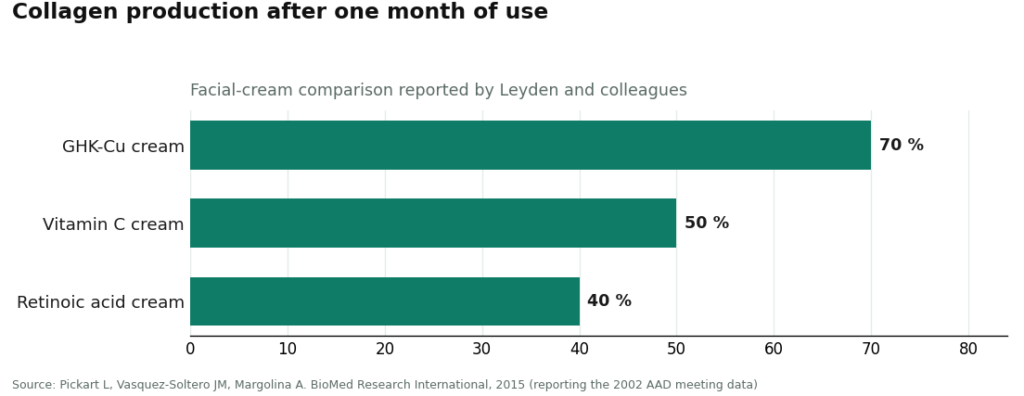
The number everyone quotes comes from a facial-cream study by Leyden and colleagues. They biopsied skin after a month of use and found collagen went up in 70% of women using the GHK-Cu cream, versus 50% on vitamin C and 40% on retinoic acid [P2]. That’s a good number! That’s the number that basically built the whole copper-peptide skincare aisle.
But, and I say this as someone who reads footnotes for fun, that headline result was presented at a 2002 dermatology conference, as a proceeding, not published as a full peer-reviewed paper [P2]. So think of it as “genuinely encouraging clinical-grade data” rather than “gold-standard proof.” Beyond that one study, other reviews back up the general pattern of better skin density, elasticity, and collagen with topical use [P2][P3].
And it’s not a perfect record, which I actually find reassuring, because a peptide with zero misses would smell like marketing copy. A 2006 randomized trial in Archives of Facial Plastic Surgery tested a topical copper tripeptide on people healing from CO2 laser resurfacing, and found no real improvement in redness, wrinkles, or skin quality, objectively speaking, even though people said they liked using it [P6]. A real peer-reviewed trial landed flat. So the honest read on topicals is “promising, well-supported, not a slam dunk every time.”
See also: Webmailehealth: a Deep Dive Into Web-Based Health
The part where the resume goes blank
Now for the other guy. The pitch for injecting this stuff to get body-wide benefits, faster healing everywhere, less inflammation, more collagen head to toe, rests almost entirely on those lab and animal studies I mentioned. Real work, but not the same thing as testing it in people.
A 2020 review in Aging Pathobiology and Therapeutics looked at GHK as an anti-aging candidate and was pretty upfront: the repair and antioxidant effects it describes come from in-vitro and animal studies, and the authors themselves say we need more research, in both preclinical work and actual humans [P5]. Translation: nobody has really run the trial that would tell you whether injecting this does what people online claim it does.
That doesn’t make it a scam. It makes it unproven, which is a different category entirely. The chemistry is plausible, the mechanism checks out on paper, there might genuinely be something there. But “looks great in a dish” and “proven in people” are not the same sentence, and a lot of what’s sold as injectable GHK-Cu quietly swaps one for the other. If you remember nothing else from this article, remember to ask “topical or injectable?” every single time someone tells you what this peptide does.
Okay but what’s the actual dose
Here’s the annoying truth: most of the dosing chatter you’ll find online is about the injectable form, and almost none of it traces back to an actual controlled human trial, because those trials mostly don’t exist. For a cream, dosing barely matters, it’s a concentration in a serum, you rub it on, the stakes are low because it’s sitting on top of your skin. For something you’re injecting into your whole system, dosing is a real medical question, and right now the published research just doesn’t hand you a validated number.
This is exactly the kind of situation where “some guy in a forum said 2mg” is a genuinely bad way to make a decision, and where an actual prescriber earns their keep. If someone’s dead set on trying the injectable route, going through a licensed telehealth provider like FormBlends means an intake gets reviewed by a prescriber, a script only gets written if it fits the person, and a licensed compounding pharmacy makes the actual product. Compare that to a gray-market site shipping a “research use only” powder with no instructions and no one to call if something feels wrong. Supervision doesn’t magically turn thin evidence into thick evidence, I want to be clear about that, but it does mean an actual medical license is behind the decision, and there’s a human to reach out to.
And is it safe?
Split answer, same as everything else here. Topically, the track record’s pretty reassuring, mild irritation is about the worst most people report. Injected, systemically, there just isn’t much controlled human safety data to lean on, and there are a couple of copper-specific things worth naming out loud: your body regulates copper pretty carefully, so casually injecting a copper peptide without oversight isn’t the same low-stakes move as dabbing on a serum. And reconstituting powder and self-injecting carries the usual risks that come with that, sterility, technique, all of it. None of this means injecting GHK-Cu is dangerous, full stop. It means the safety data for that route is thin, and thin data is its own reason to slow down.
The takeaway I’d actually text a friend
GHK-Cu is real, it’s naturally yours, and the mechanism is genuinely interesting. As a face cream, it’s got small but legitimate human studies behind it, which is why it’s a mainstream skincare category and not some fringe TikTok thing. As an injectable meant to work on your whole body, the human evidence is basically not there yet, and the “resets your cells” language is borrowed from lab work, not from people actually trying it.
So next time you see a claim about this peptide, just ask: is this about a cream, or a needle? Same molecule, wildly different level of proof.
Questions I’d ask if I were you
Is there actual human proof for GHK-Cu, or is it all petri dish stuff? Both, honestly, and that split is the whole story. On skin, there’s real controlled human data stretching back over twenty years, including that facial-cream study where collagen went up in 70% of women using it. Injected, whole-body use is a different picture entirely, close to no human evidence, mostly cell and animal studies behind the repair and anti-inflammatory claims.
Is putting on a cream basically the same as injecting this stuff? Nope, and that mix-up is the most common one I see. Same molecule, totally different evidence trail. The cream sits on your skin, has decades of cosmetic use behind it, low stakes. The injectable works on your whole system, has thin safety and efficacy data in humans, and involves copper, which your body regulates carefully. Different situation, full stop.
Where’s this “resets your cells” claim even coming from? From lab work on gene expression, not from people. Reviews describe it influencing something like 4,000 human genes tied to repair and inflammation, but that was measured in cells and tissue models. Nobody’s shown that jump happens the same way when you inject it into an actual person.
Has a human trial ever come back and said it didn’t work? Yes, actually. A 2006 randomized trial in Archives of Facial Plastic Surgery tested a topical copper peptide on people recovering from laser resurfacing and found no real objective improvement in wrinkles, skin quality, or redness, even though people said they liked using it. A fair look at the evidence includes that miss right alongside the wins.
Is there a proven injectable dose? No, not really. Most numbers floating around online aren’t tied to any controlled human trial, because those trials mostly haven’t happened. For a serum, low stakes, doesn’t matter much. For something you’re injecting to act body-wide, that’s a real medical question without a solid published answer yet.
If someone’s going to try the injectable version anyway, what’s the smarter path? Go through a licensed telehealth provider instead of some gray-market powder seller. With something like FormBlends, a prescriber actually reviews your intake, only writes a script if it makes sense for you, and a licensed pharmacy compounds the actual product. That doesn’t turn weak evidence into strong evidence, but it puts a real medical license behind the call, and gives you someone to reach if things feel off, unlike a “research use only” powder with zero instructions.
What is GHK-Cu and where does it come from?
GHK-Cu is a copper peptide your body makes on its own, first pulled out of human plasma back in the early 1970s. Levels drop noticeably as you get older, and it turns up in saliva and urine too. Scientists got curious because it seemed to switch on wound-repair genes, which raised the question of whether you could put that to use on purpose.
What does GHK-Cu actually do in the body?
In lab and animal work, it’s shown up as helpful for collagen production, calming inflammation, and supporting wound healing, and it looks like it nudges gene expression in ways that seem promising for skin. The catch is that most of the convincing evidence comes from cell cultures and rodents. Human trials are still small and limited, so it’s too early to say firmly what happens in real people.
Is GHK-Cu safe to use?
Topically, it’s got a pretty clean track record in the studies out there, not much irritation reported. Injectable versions are a different story. It’s not FDA-approved for injection, and peptides sold that way often don’t have verified purity or sterility behind them. If you’re going the injectable route anyway, a physician-supervised compounding pharmacy like FormBlends is a much more accountable choice than a random research-chemical site.
Does GHK-Cu help with acne?
Maybe, but the evidence is thin and mostly indirect. Its anti-inflammatory qualities could theoretically help with acne redness and swelling, and some people point to its role in skin remodeling for scarring afterward. What’s missing is a solid clinical trial actually testing it against acne in humans. Calling it a proven acne treatment would be getting ahead of what we actually know.
References
- Pickart L, Thaler MM. Tripeptide in human serum which prolongs survival of normal liver cells and stimulates growth in neoplastic liver. Nature New Biology, 1973;243(124):85-7. Original isolation of GHK from human serum. https://pubmed.ncbi.nlm.nih.gov/4349963/
- Pickart L, Vasquez-Soltero JM, Margolina A. GHK Peptide as a Natural Modulator of Multiple Cellular Pathways in Skin Regeneration. BioMed Research International, 2015. Plasma GHK ~200 ng/mL at age 20 declining to ~80 ng/mL at age 60; up- and down-regulation of roughly 4,000 human genes; Leyden 2002 facial-cream collagen comparison (70% GHK-Cu vs 50% vitamin C vs 40% retinoic acid), reported as a 2002 American Academy of Dermatology meeting proceeding. https://pmc.ncbi.nlm.nih.gov/articles/PMC4508379/
- Pickart L, Margolina A. Regenerative and Protective Actions of the GHK-Cu Peptide in the Light of the New Gene Data. International Journal of Molecular Sciences, 2018;19(7):1987. Gene-expression and tissue-remodeling mechanism review.
- Dou Y, Lee A, Zhu L, Morton J, Ladiges W. The potential of GHK as an anti-aging peptide. Aging Pathobiology and Therapeutics, 2020;2(1):58-61. Review of GHK repair, antioxidant, and anti-inflammatory effects from in-vitro and in-vivo studies, calling for further preclinical and clinical aging research.
- Miller TR, Wagner JD, Baack BR, Eisbach KJ. Effects of topical copper tripeptide complex on CO2 laser-resurfaced skin. Archives of Facial Plastic Surgery, 2006;8(4):252-9. Randomized controlled human trial; no significant objective improvement in skin quality or post-treatment erythema, higher patient satisfaction.
Written by Bianca Moreno, health features writer. Working from the primary literature cited above. Last reviewed January 2026.
This content is informational and not a diagnosis or treatment plan. Talk to your doctor.

